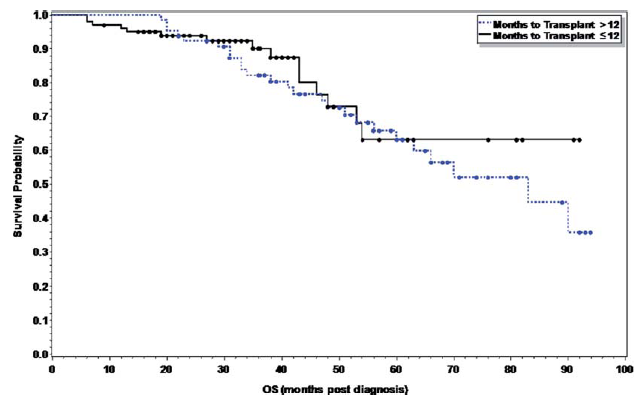
Wondering if there is a reason why the line for early transplant flattens out at 50+ months.
This tells me that survival rate is 63% for early transplant from 52 months on and up to 90+ months and never decreases. Whereas survival probablity drops off to 35% at 90 months for delayed transplant.
Thoughts?
(Also, here is a larger version of the file.)
Moderator's Note:
The above graph is from "Early Or Late Stem Cell Transplantation For Myeloma? New Study Finds Both Strategies Yield Similar Overall Survival," The Myeloma Beacon, Aug 16, 2013, which summarizes the results of this study:
NC Dunavin et al, "Early versus delayed autologous stem cell transplant in patients receiving novel therapies for multiple myeloma," Leukemia & Lymphoma, Aug 2013 (link to abstract).
Forums
-

gardengirl - Name: gardengirl
- Who do you know with myeloma?: Me
- When were you/they diagnosed?: Nov. 2013
- Age at diagnosis: 47
Re: Early vs delayed SCT overall survival graph
It looks from the 'points' plotted that there are more individuals in the delayed group compared to the early transplant group. This could affect the plot of the graph as can many factors regarding the individuals in the two groups.
Re: Early vs delayed SCT overall survival graph
What if you have a second transplant at, say, 40 months?
-

Sharon01 - Name: Sharon
- Who do you know with myeloma?: Self
- When were you/they diagnosed?: September 2014
- Age at diagnosis: 48
Re: Early vs delayed SCT overall survival graph
Although I think the flat-lining of the survival curve for the early transplant group is interesting, I would be hesitant to draw too many conclusions based on it.
I think that, by the time you are getting out to overall survival times of 5 or 6 years in a relatively small study like this, the researchers have lost track of a lot of the patients. So the survival estimates for those sorts of survival times are relying on a limited number of results.
Also, I wouldn't interpret the flat line for the one group as indicating that the line will never go down. The observation period just hasn't gotten long enough to pick up the eventual drop in the line at longer survival times. People see plateaus in curves like these and think they'll go on forever. Then, an update comes out in a year or two, and lo and behold, the plateau is no longer a plateau, just a temporary flattening.
I would also mention that there is some difference between the groups in what the initial treatments were that they got. As the article mentions,
Some might argue that the difference between the groups in how many people got Velcade and thalidomide might have affected the results to the advantage of the early transplant group.
The study is a retrospective study, meaning that patients did not get the same upfront treatments, and we really don't know why some got early transplants and some got late transplants.
I think that, by the time you are getting out to overall survival times of 5 or 6 years in a relatively small study like this, the researchers have lost track of a lot of the patients. So the survival estimates for those sorts of survival times are relying on a limited number of results.
Also, I wouldn't interpret the flat line for the one group as indicating that the line will never go down. The observation period just hasn't gotten long enough to pick up the eventual drop in the line at longer survival times. People see plateaus in curves like these and think they'll go on forever. Then, an update comes out in a year or two, and lo and behold, the plateau is no longer a plateau, just a temporary flattening.
I would also mention that there is some difference between the groups in what the initial treatments were that they got. As the article mentions,
Both groups of patients had similar exposure to induction therapy with Revlimid (33 percent of the early transplant group and 28 percent of the late transplant group), but the early transplant group had more patients who had received Velcade-based therapy (63 percent versus 49 percent) and the late transplant group had more patients who had received thalidomide-based therapy (66 percent versus 38 percent)."
Some might argue that the difference between the groups in how many people got Velcade and thalidomide might have affected the results to the advantage of the early transplant group.
The study is a retrospective study, meaning that patients did not get the same upfront treatments, and we really don't know why some got early transplants and some got late transplants.
Re: Early vs delayed SCT overall survival graph
I find the flat line interesting and yet confusing, as it implies long-term survival in 60% of those with early SCT. Can that be right?
-

blair77 - Who do you know with myeloma?: My husband
- When were you/they diagnosed?: April 2013
- Age at diagnosis: 43
Re: Early vs delayed SCT overall survival graph
So I asked my doctor about it today and he said that one possibility is that there may be a small number of people left (say only 5) and, at some point, they will all pass and the line will drop dramatically, instead of a slower slope. Bottom line, he felt, is that the end result is the same for both groups.
-

gardengirl - Name: gardengirl
- Who do you know with myeloma?: Me
- When were you/they diagnosed?: Nov. 2013
- Age at diagnosis: 47
6 posts
• Page 1 of 1
Return to Treatments & Side Effects