

I was found to have an M-protein 6 months ago of 0.2 g/dL (2 g/l). Repeat last month was 0.3 g/dL. Immunofixation declared a IgG lambda in the serum.
My doctor than ordered a free light chain ratio, which was normal at 1.54, but my kappa level was high at 19.6. Nothing in my urine. All other labs normal.
How worrisome is the elevated kappa in light of the normal ratio? What do these lab results mean in terms of what I can expect going forward?
I haven't been to a hematologist yet, but plan on making an appointment soon.
I am just now comprehending that I have a risk of developing multiple myeloma for the rest of my life.
 Forums
 6 posts
• Page 1 of 1
6 posts
• Page 1 of 1

Re: 0.3 M-spike, high kappa FLC, normal K/L: what to expect?
Hi Howard,
Welcome to the forum.
I'm assuming that the normal reference ranges and units of measure of your serum free light chains are as follows:
3.3 to 19.4 mg/L kappa free light chains
5.71 to 26.3 mg/L lambda free light chains
0.26 to 1.65 ratio of kappa/lambda
If this is the case, then your kappa free light chain number is just barely out of range and your lamda free light chain number is in range.
With an m-protein (m-spike) level of 0.2 - 0.3 g/dL, you would appear to be just barely registering as having MGUS. The risk of IgG-type MGUS progressing to symptomatic myeloma is on the order of 1%/year. Also note that a lot of people in the world have MGUS, but never realize it and and are never any the worse for it over the span of their lives. So try not to fret too much about the possibility of a diagnosis of MGUS.
But given that you have such a small m-spike, coupled with a barely high kappa number, a normal lambda number and a normal ratio, your doctor should also consider the much lesser possibility that your m-spike might be transient and that you are instead suffering from a polylconal (non-cancerous) rise in your free light chains or that there may be some renal impairment that is to blame . I suggest this as a possibility because of this table:
http://www.rmlonline.com/images/free-lite/fl-interp01-lg.gif
Note that some simple things like infections can cause a polylconal rise in free light chains. It would be good to also look at your quantitative IgG, IgA and IgM levels to see what they are doing.
In any case, seeing a hematologist would be a good thing to do. If you let us know what city you are in, folks on this site can recommend some good hematologists or facilities in your area that specialize in myeloma.
Welcome to the forum.
I'm assuming that the normal reference ranges and units of measure of your serum free light chains are as follows:
3.3 to 19.4 mg/L kappa free light chains
5.71 to 26.3 mg/L lambda free light chains
0.26 to 1.65 ratio of kappa/lambda
If this is the case, then your kappa free light chain number is just barely out of range and your lamda free light chain number is in range.
With an m-protein (m-spike) level of 0.2 - 0.3 g/dL, you would appear to be just barely registering as having MGUS. The risk of IgG-type MGUS progressing to symptomatic myeloma is on the order of 1%/year. Also note that a lot of people in the world have MGUS, but never realize it and and are never any the worse for it over the span of their lives. So try not to fret too much about the possibility of a diagnosis of MGUS.
But given that you have such a small m-spike, coupled with a barely high kappa number, a normal lambda number and a normal ratio, your doctor should also consider the much lesser possibility that your m-spike might be transient and that you are instead suffering from a polylconal (non-cancerous) rise in your free light chains or that there may be some renal impairment that is to blame . I suggest this as a possibility because of this table:
http://www.rmlonline.com/images/free-lite/fl-interp01-lg.gif
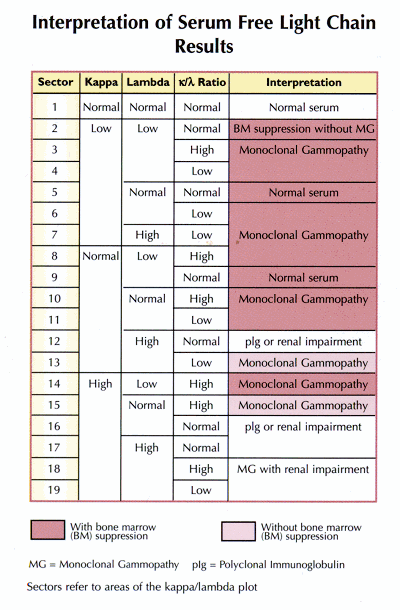
Note that some simple things like infections can cause a polylconal rise in free light chains. It would be good to also look at your quantitative IgG, IgA and IgM levels to see what they are doing.
In any case, seeing a hematologist would be a good thing to do. If you let us know what city you are in, folks on this site can recommend some good hematologists or facilities in your area that specialize in myeloma.
-

Multibilly - Name: Multibilly
- Who do you know with myeloma?: Me
- When were you/they diagnosed?: Smoldering, Nov, 2012
Re: 0.3 M-spike, high kappa FLC, normal K/L: what to expect?
Multibilly,
Thank you for responding to me post. I just reviewed again my labs and I also notice that I had kappa free light chains in my urine. Even though it stated that it was in the reference range. I read that these are called Bence Jones proteins, and people should not have them.
Even though it is stated that it is in the reference range, does this add to the prognosis or diagnosis?
Even though my creatinine has been stable for years at around 1.2 I am starting to think that I might have some renal insufficiency.
Thank you for responding to me post. I just reviewed again my labs and I also notice that I had kappa free light chains in my urine. Even though it stated that it was in the reference range. I read that these are called Bence Jones proteins, and people should not have them.
Even though it is stated that it is in the reference range, does this add to the prognosis or diagnosis?
Even though my creatinine has been stable for years at around 1.2 I am starting to think that I might have some renal insufficiency.
Re: 0.3 M-spike, high kappa FLC, normal K/L: what to expect?
Having some number of polyclonal (healthy) free light chains in one's urine is normal. What's not normal is having monoclonal free light chains in one's urine. Monoclonal free light chains in the urine are indeed known as Bence Jones proteins (also known as a urine m-spike, which is not to be confused with the very different serum m-spike).
In order to accurately detect and measure Bence Jones proteins in one's urine, you need to do a 24-hour urine protein electrophoresis (UPEP) test, which includes a urine immunofixation test to detect the presence of monoclonal protein.
Was your urine test based on a 24-hour collection? A spot or random urine test is not that helpful in diagnosing a monoclonal gammopathy.
When a hematologist looks at all of your serum and 24-hour urine test results, he/she can pretty easily determine if you have any renal insufficiency. A creatinine level of 1.21 g/dL by itself is not really indicative of having any sort of significant renal issues, but only a doctor can make that call.
BTW, whenever you post your lab figures, it's always very helpful if you include the units of measure and the reference ranges from your lab tests (all labs use different units of measure and have different reference ranges, so it's important to include these figures).
In order to accurately detect and measure Bence Jones proteins in one's urine, you need to do a 24-hour urine protein electrophoresis (UPEP) test, which includes a urine immunofixation test to detect the presence of monoclonal protein.
Was your urine test based on a 24-hour collection? A spot or random urine test is not that helpful in diagnosing a monoclonal gammopathy.
When a hematologist looks at all of your serum and 24-hour urine test results, he/she can pretty easily determine if you have any renal insufficiency. A creatinine level of 1.21 g/dL by itself is not really indicative of having any sort of significant renal issues, but only a doctor can make that call.
BTW, whenever you post your lab figures, it's always very helpful if you include the units of measure and the reference ranges from your lab tests (all labs use different units of measure and have different reference ranges, so it's important to include these figures).
-
Multibilly - Name: Multibilly
- Who do you know with myeloma?: Me
- When were you/they diagnosed?: Smoldering, Nov, 2012
Re: 0.3 M-spike, high kappa FLC, normal K/L: what to expect?
I can't tell you how much I appreciate this dialogue and having someone to discuss this with. I'm looking forward to speaking to a hematologist and will probably talk to more than one.
Back in April my serum immunofixation reported an IgG lambda band. A random urine electrophoresis was done, which stated that my protein was too low to calculate excretion. They did a urine immunofixation that reported a normal pattern and no monoclonal proteins detected.
Last week after seeing the results , my primary doctor ordered the serum free light chain test, which showed a normal ratio of 1.53 with a lambda of 12.8 mg/L (range 5.7 to 26.3) and a kappa of 19.6 mg/L with a range of 3.3 -19.4. Slightly elevated.
The urine free kappa was 3.63 with a range of 1.35-24.19 mg/L.
There was no reported urine free lambda.
Since my monoclonal gammopathy is IgG lamba, I would have suspected some lambda in the urine.
I can 't help but think that the urine free kappa light chain is an issue since it is the only light change isolated.
I read that normal people shouldn't have any light chains in their urine because they are usually reabsorbed but since there is a reference range, I have to assume that it is not entirely abnormal.
Very confusing.
Back in April my serum immunofixation reported an IgG lambda band. A random urine electrophoresis was done, which stated that my protein was too low to calculate excretion. They did a urine immunofixation that reported a normal pattern and no monoclonal proteins detected.
Last week after seeing the results , my primary doctor ordered the serum free light chain test, which showed a normal ratio of 1.53 with a lambda of 12.8 mg/L (range 5.7 to 26.3) and a kappa of 19.6 mg/L with a range of 3.3 -19.4. Slightly elevated.
The urine free kappa was 3.63 with a range of 1.35-24.19 mg/L.
There was no reported urine free lambda.
Since my monoclonal gammopathy is IgG lamba, I would have suspected some lambda in the urine.
I can 't help but think that the urine free kappa light chain is an issue since it is the only light change isolated.
I read that normal people shouldn't have any light chains in their urine because they are usually reabsorbed but since there is a reference range, I have to assume that it is not entirely abnormal.
Very confusing.
Re: 0.3 M-spike, high kappa FLC, normal K/L: what to expect?
Again, don't rely on a random urine sample for diagnosing monoclonal gammopathies. It takes a very large volume of urine, delivered over a long period of time (24 hours), that a lab will then distill down in order to accurately detect any Bence Jones proteins. It's also not a given that any Bence Jones proteins will even show up in a 24-hour urine sample given that you have a such a small serum M-spike and your involved serum lambda number is barely out of range.
A 24-hour urine test will also give you far better data for evaluating renal function.
But keep in mind that doing 24-hour urine tests is really a matter of personal preference for hematologists. Some doctors swear by them ,and others rely fairly exclusively on serum tests when it comes to diagnosing monoclonal gammopathies.
A 24-hour urine test will also give you far better data for evaluating renal function.
But keep in mind that doing 24-hour urine tests is really a matter of personal preference for hematologists. Some doctors swear by them ,and others rely fairly exclusively on serum tests when it comes to diagnosing monoclonal gammopathies.
-
Multibilly - Name: Multibilly
- Who do you know with myeloma?: Me
- When were you/they diagnosed?: Smoldering, Nov, 2012
6 posts
• Page 1 of 1